Big ERP Vendors Are Chasing "Vertical AI Modules" — What That Actually Means for a Single-Till Shop
We build Pultrack, a point-of-sale and inventory app for small retailers who deal with two currencies, patchy internet, and razor-thin margins — so when a headline says "ERP innovation" is accelerating, we read closely to see if it's actually relevant to a shop owner counting stock by hand at closing time. Usually the answer is: partly, and only if you translate the jargon first.
What's actually new in global ERP right now?
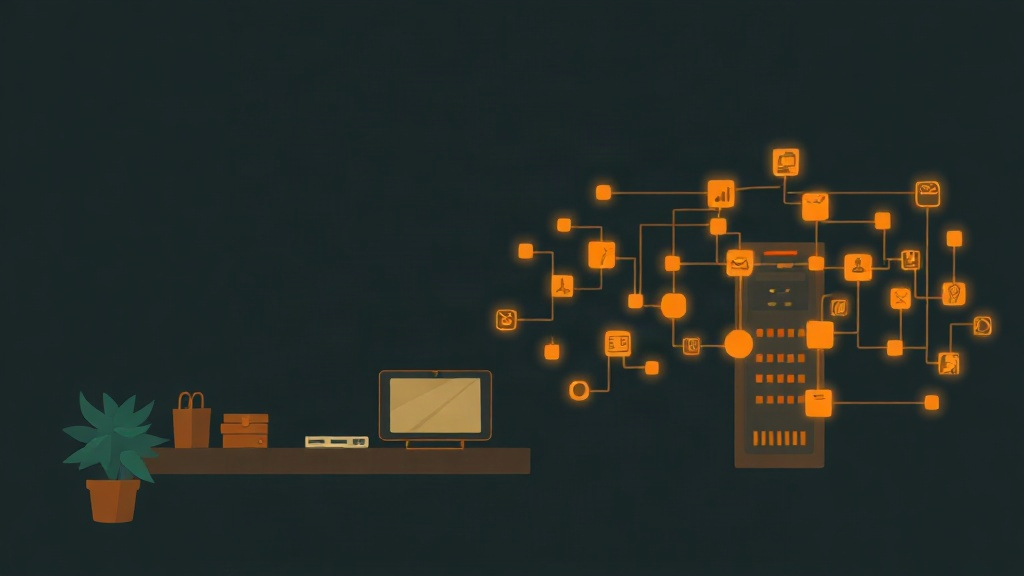
A recent market overview of the global Enterprise Resource Planning (ERP) software industry frames the current shift clearly: vendors are moving away from monolithic, on-premise, all-in-one suites toward cloud-native, modular, AI-embedded platforms, often built around specific industries rather than generic business processes.[1] The same overview reports that cloud-based ERP already accounted for roughly 65% of global revenue in 2024, with growth concentrated in subscription-based SaaS deployments that are faster to roll out than traditional installed software.[1]
Three things stand out in that framing:
- Composable deployment — instead of buying one giant system, a business licenses modules (finance, inventory, HR, CRM) that plug into each other, adding or removing pieces as needed.[1]
- Embedded predictive analytics — forecasting, anomaly detection, and automated workflows are being built directly into the core product rather than sold as a bolt-on add-on.[1]
- Vertical-specific modules — ERP vendors are tailoring features for particular industries (manufacturing, distribution, healthcare, retail chains) rather than shipping one configuration for everyone.[1]
Why is CRM converging with ERP?
The same research also points to CRM moving closer to ERP functionally — AI-powered lead scoring, sales enablement, and customer service tools increasingly sit inside the same platform as finance and supply-chain modules, rather than in a separate system that has to be integrated manually.[1] The logic is straightforward for a large company: if sales, finance, and inventory data live in one place, a sales manager can see whether a deal is actually fulfillable before it's promised, and finance can forecast revenue from CRM pipeline data without exporting spreadsheets between systems.
This convergence matters for companies running multi-entity operations, multiple warehouses, or multi-country sales teams — the kind of business where a delayed shipment in one region needs to trigger a finance adjustment and a customer service flag simultaneously. It's a genuinely useful architectural shift. It's also a solution to a problem that doesn't exist in a shop that has one counter, one shopkeeper, and maybe two employees.
Is this relevant to a small retail shop at all?
Only indirectly, and it's worth being honest about that rather than stretching the connection. Enterprise ERP innovation — the kind covered in vendor market research — is aimed at organizations with departments: separate finance, procurement, sales, and operations teams that each need their own view of shared data. The "vertical modules" being discussed are things like manufacturing shop-floor scheduling or multi-warehouse logistics optimization, not "track two currencies on one shelf" or "know which sachets sell before the weekend."
Where the ideas do transfer, in simplified form, are these:
- Cloud-native and modular matters for small shops too — you don't want software that forces you to buy inventory, payroll, and accounting features you'll never use just to get a working till.
- Embedded intelligence — even a simple "you're low on cooking oil" alert is a tiny, shop-scale version of the "predictive analytics" enterprise vendors are marketing. The concept is the same; the stakes and complexity are wildly different.
- Vertical focus — the enterprise argument for industry-specific ERP is the same argument for retail-specific POS over generic accounting software: purpose-built beats general-purpose when the workflows are genuinely different.
What should a shop owner actually watch for?
The risk with "AI-embedded ERP" headlines trickling into small-business marketing is that vendors borrow the language — "AI-powered," "intelligent automation," "predictive" — without the underlying substance that makes it useful at enterprise scale, which is deep integration across departments and large transaction volumes to train models on. A single shop generating a few dozen transactions a day doesn't have the data volume that makes "predictive analytics" statistically meaningful in the way it is for a company processing thousands of orders across regions.
So when evaluating software that claims to bring "ERP-grade intelligence" to a small shop, it's worth asking:
- Does this feature actually need my sales history, or is it a generic rule dressed up as AI?
- Does the "vertical" version genuinely reflect how a corner shop operates — cash and card mixed with informal credit, two currencies, irregular supplier deliveries — or is it a retail chain template with a different logo?
- Is the core software usable offline, at the counter, in the seconds between customers — regardless of how sophisticated the backend analytics are?
Where does Pultrack sit in this picture?
We're not building an ERP, and we don't pretend to be. The enterprise trend toward composable, AI-embedded, vertical platforms is a real and well-documented shift for organizations that need to coordinate finance, sales, and operations across departments and locations.[1] Our job is narrower and, we think, more useful for the businesses we actually serve: make sure a single shop with one till, two currencies, and unreliable internet can ring up a sale, keep accurate stock counts, and close out the day without needing a finance department to interpret the numbers. If "vertical-focused platforms" is the right phrase for what large ERP vendors are building for manufacturers and distributors, the honest equivalent for us is "built only for the shop counter" — not a scaled-down enterprise suite, but a different category of tool solving a different, smaller-scale problem.
It's also worth flagging plainly: much of the current wave of "ERP/CRM innovation" coverage circulating online is vendor-sponsored comparison content and market-research summaries rather than independent reporting, so treat superlative claims ("best global ERP," "top platforms of 2026") with the same skepticism you'd apply to any paid placement — the underlying shift toward cloud, AI features, and modularity is credible, but the rankings themselves often aren't neutral.