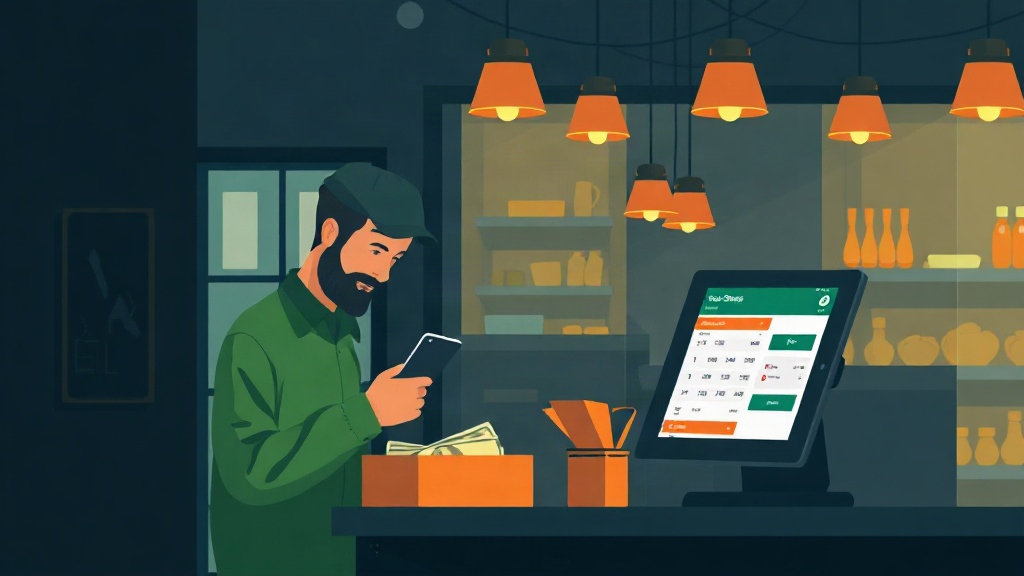
The One-Person Store Closing: How Offline-First POS Actually Handles End-of-Day Without a Manager
We build Pultrack, a point-of-sale and inventory app for small shops that run on dual currencies and unreliable connections, so we read every "offline-first POS" writeup that shows up online. Most of them — and there have been a lot lately — focus on the same moment: the register still works when the internet drops. That's true and important. But it's not the moment that actually determines whether a one-person shop stays organized. That moment is closing time, when the owner has to lock the door, count the drawer, and make sense of a day's worth of sales, restocks, and cash movements — usually alone, usually tired, and often with no manager or bookkeeper to double-check anything.
Why does "offline-first" keep getting framed as a checkout problem?
The recent wave of offline-first POS content — from engineering deep-dives to vendor product pages — converges on a fairly consistent architecture: the device stores each sale locally first, runs inventory and receipt logic on-device, and only talks to the cloud later for syncing and reporting.[1][2] That's a real shift from older "offline mode" designs, where a spotty connection just meant the app froze or blocked checkout until a server responded.[3][4] The practical case for this is easy to make in emerging markets: connectivity is intermittent, power isn't guaranteed, and a shop that can't sell during an outage is a shop that loses that day's income outright.[3]
Multiple sources describe this as autonomous local operation — the store keeps scanning items, totaling receipts, and logging transactions with no server round trip required, then queues everything to sync once the connection returns.[1][2][3] Some vendors go further and describe each location as a fully independent unit, with centralized visibility restored only after sync.[2] All of that is genuinely useful. None of it says anything about what happens at 8pm when the shutter comes down.
What actually happens at closing time in a small shop?
In a shop with one owner-operator, closing isn't a single action — it's a reconciliation exercise done under time pressure:
- Counting physical cash against what the till says should be there, often across two currencies.
- Checking that stock counted on shelves roughly matches what the system logged as sold.
- Making sure any transactions made while offline actually got recorded, not just "remembered."
- Deciding what to reorder before the next day starts, based on numbers that need to be right, not approximate.
This is where offline-first architecture either earns its keep or quietly creates new headaches. If the system genuinely writes every sale, refund, and stock adjustment to local storage the instant it happens — the pattern described in recent production writeups on offline-first design — then a nightly count should match the device's own numbers almost exactly, sync pending or not.[1][4] If instead "offline mode" just means the screen doesn't crash while queuing an unclear number of pending actions, closing becomes guesswork: was that sale actually saved, or did it vanish when the app restarted?
Why does this matter more for a single-till shop than a chain?
A supermarket chain has a shift supervisor, a POS admin, and a finance team reconciling numbers the next morning. A single-till shop has none of that. The owner is the cashier, the stock clerk, and the accountant, usually in the same ten minutes at closing. That compresses the tolerance for ambiguity to almost zero — there's no one to chase down a missing transaction the next day, because there was no one else there to witness it.
This is also where the emerging-market framing in recent industry material is doing real work, even if some of it comes from vendors with an obvious interest in selling offline-first products.[5][6] The honest read is that most of the recent "offline-first is now essential" content is vendor blogs and product pages making a case for their own architecture choices, not independent research.[2][3][5] That doesn't make the underlying engineering claims false — local-first storage with deferred sync is a well-understood pattern — but it does mean the framing of it as a dramatic 2025 shift should be read with some skepticism about who's writing it and why.
What should a shop owner actually check before trusting a "closing report"?
If you're evaluating a POS on the strength of its offline claims, the closing process is a better test than the checkout demo. Worth asking:
- Does the end-of-day report include transactions made while offline, or only ones that already synced?
- Can you see, at a glance, how many transactions are still waiting to sync at closing time?
- Does the cash count reconcile per currency, if the shop deals in more than one?
- If the device is lost or damaged before syncing, what happens to that day's records?
That last question matters more than it sounds. Local-first design solves the "keep selling" problem well, but it introduces a new one: for a period of time, the phone or terminal genuinely is the only copy of the day's sales.[1][4] A good closing routine needs to make that risk visible, not hide it behind a green "all synced" checkmark that only appears once connectivity returns.
Where does Pultrack fit into this?
We built Pultrack around the assumption that closing time, not checkout, is where a small shop's books either stay clean or start drifting. Every sale, stock adjustment, and cash movement is written locally the moment it happens, and the daily close pulls from that same local ledger rather than waiting on a sync to "finish" the day's numbers — including handling both currencies a shop might be pricing and collecting in. We didn't build this because offline checkout is a novel idea; most serious POS systems now do some version of local-first storage. We built it because the owners we talked to weren't worried about losing a sale mid-transaction — they were worried about not knowing, at closing, whether the drawer and the app actually agreed.
What's the realistic takeaway for small shops evaluating this?
Offline-first is a genuinely useful architecture, and the recent wave of writeups describing local-first storage with deferred sync reflects a real, if incremental, engineering shift rather than pure marketing.[1][3][4] But the feature that actually protects a small shop's day isn't "it works without internet" — it's whether the numbers you count at closing match the numbers the app kept while you weren't watching. Ask vendors about that, not just about whether the register freezes during an outage.